




304 and 316L Stainless Steels Differ in Laser-Cut Bending Sections
2026-11-25 16:23:32
Introduction: Both grades are austenitic medical stainless steels, and the choice between them usually comes down to corrosion margin and forming behavior in thin slotted tubing.
Designers comparing 304 and 316L for a laser-cut bending section often expect a clear winner. What they usually find is a pair of alloys that overlap far more than they differ: same crystal family, same passive oxide layer, same ability to be laser-cut into slots and hinges and then bent into a controlled curve. The decision turns on two narrower questions instead. How much corrosion margin does the device actually need, and how does the alloy behave when a thin ligament is asked to bend repeatedly? Getting those two questions straight is what separates a comfortable material choice from an arbitrary one.
What 304 and 316L Stainless Steels Share in a Laser-Cut Bending Section
Both grades belong to the austenitic stainless family, which means they carry roughly 18% chromium and enough nickel to hold an austenitic structure at room temperature. That structure is non-magnetic in the annealed condition and cannot be hardened by heat treatment; it gains strength through cold work instead. The practical consequence is a continuous chromium oxide layer that reforms in air after cutting, which is the reason a freshly laser-cut slot edge does not simply start rusting the moment it cools. For a bending section, the alloy also sets the baseline for how much local strain a hinge ligament can take before it complains. The stainless steels share something else that matters at the design stage: they both convert a straight microtube into a working bending section without changing the basic manufacturing idea. Slots are cut, ligaments are left between them, and the tube deflects through those ligaments. SINOWARES builds laser-cut bending sections from medical-grade 304 and 316L microtubes using that same slot-and-hinge approach, with custom outer diameter, wall thickness, bend radius, length, and slot profiles. At the base level the two grades behave alike enough that an experienced designer can read one drawing against either material. That overlap is why grade choice rarely rescues a poorly conceived structure, and why a good structure can usually be built in either alloy. The differences live at the edges of the work, not at its center: what the tube touches, and what happens to thin metal when it is asked to bend.
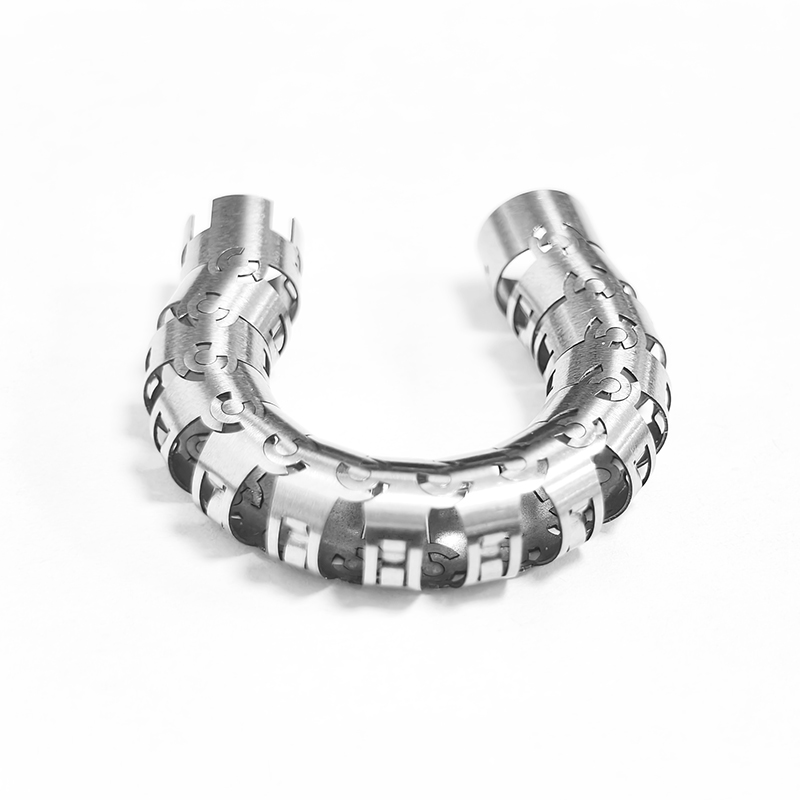
Where 304 and 316L Differ in Corrosion Resistance and Forming Behavior
The composition split is small but meaningful. 316L adds roughly 2–3% molybdenum, which 304 does not carry, and holds carbon to about 0.03% instead of the higher level typical of standard 304. Molybdenum is the element that raises resistance to pitting and crevice attack in chloride-bearing environments, which is exactly the kind of environment created by saline, body fluids, and many cleaning chemistries. The low carbon level of the "L" grades matters at weld joints and other thermally touched zones, where carbon has less opportunity to tie up chromium. Published grade references describe this molybdenum effect as the core corrosion difference between the two alloys. The mechanical split runs the other way from what many people assume. Typical annealed 304 is listed around 505 MPa tensile strength and 215 MPa yield, while 316L is listed around 485 MPa tensile and 170 MPa yield. So 304 is the stronger of the two in the soft, as-delivered condition, and 316L is the more yielding one. In a bending section, that shows up as feel: a 304 ligament starts to deflect at a higher load and pushes back harder on the tooling that forms it, while a 316L ligament of the same geometry begins moving earlier and returns less when the forming force is released. Both grades work-harden as they deform, so the difference is most visible on the first bend and fades as the metal stiffens. Published values describe typical behavior for the alloy family rather than test results for any particular tube, and no grade-specific corrosion or fatigue test data is attached to these bending sections. The right reading is that 316L buys corrosion margin with a slightly softer, more compliant starting condition, while 304 buys strength and stiffness with a smaller chloride margin.
How Grade Differences Change the Way a Bending Section Is Designed
A useful way to see this in action is a design review where two engineers hold up a 304 candidate and a 316L candidate for the same slotted microtube. They do not argue about which metal is "better." They list which surfaces of the finished instrument will contact fluid, how often the part will flex, and what the tube is joined to at each end. Those three answers usually settle the grade before anyone opens a drawing.
1. Corrosion Margin Matters More Once the Tube Meets Fluids
Slot geometry is a crevice generator. Every narrow gap between adjacent cut features is a place where fluid can sit undisturbed, and stagnant chloride solution inside a crevice is the classic setup for pitting. That is where 316L earns its place: the molybdenum addition raises the threshold before localized attack starts, which matters for tubes exposed to saline irrigation, blood contact, enzymatic cleaning, or repeated disinfection cycles. On a device that only sees dry assembly and sealed packaging, the same margin is nice to have but rarely decisive. The device environment, cleaning protocol, and single-use versus reusable status set how much margin is worth paying for.
2. Formability Shapes How Slots and Bends Behave
Grade also changes what happens on the shop floor. Because 304 carries a higher yield point, it resists the forming tool more and springs back further, so fixtures and bend schedules often need a little more compensation. 316L asks less force and returns less, which makes it friendlier for tight local deformation around hinge ligaments, though its lower strength means the finished section deflects under lighter loads. Where a tube gets welded to a hub or another component, the low carbon content of 316L also reduces the chance of chromium depletion near the joint, which keeps the corrosion story consistent from tube to assembly.
Conclusion
304 and 316L are close cousins, and that closeness is the real message. Both support laser-cut slot and hinge structures, both hold a controlled bend, and both can be specified with custom outer diameter, wall thickness, bend radius, length, and slot profiles. The choice comes down to ranking two risks: localized corrosion in fluid-wetted crevices, where 316L offers more margin, and stiffness with forming resistance, where 304 offers more of both. Designers who later discuss a build with a custom endoscope bending section supplier can bring those two priorities instead of a generic preference, and the material conversation becomes short.
FAQ
Q: What is the main difference between 304 and 316L stainless steel in bending sections?
A: The main difference is molybdenum. 316L contains roughly 2–3% molybdenum, which raises resistance to pitting and crevice corrosion in chloride environments such as saline and body fluids, while 304 has none added. The second difference is mechanical: annealed 304 is listed with higher yield and tensile strength, so it feels stiffer and springs back more, whereas 316L starts softer and deforms at lower load. Both are austenitic and both laser-cut and bend well.
Q: Does 316L always perform better than 304 in laser-cut bending tubes?
A: No. 316L is the stronger choice when the tube repeatedly contacts chloride-bearing fluids or sits in cleaning chemistries, because the extra molybdenum widens the corrosion margin inside slot crevices. In a dry, sealed, single-use assembly, that margin may buy little, while 304 delivers more stiffness and forming resistance from the same geometry. The right answer depends on fluid exposure, cleaning routine, and how much deflection force the section needs to carry.
Q: How does material grade affect the way a bending section is designed?
A: Grade changes the assumptions behind the drawing rather than the drawing itself. With 316L, designers can accept tighter crevices and more aggressive cleaning without eating into corrosion margin, and they can plan for lower forming forces and less springback. With 304, they get a stiffer section and stronger ligaments but should keep fluid-wetted gaps and chloride exposure in mind. Slot layout, ligament width, and joint design then follow from whichever risk matters more.
Sources / References
Stainless Steel - Grade 304 (UNS S30400)
Stainless Steel - Grade 316L (UNS S31603)
Related Examples
Recommended reading
- 2026-11-25304 and 316L Stainless Steels Differ in Laser-Cut Bending Sections
- 2026-11-17What to Send a Custom Endoscope Bending Section Supplier for a Quote
- 2026-11-05How to Evaluate a Hysteroscopic Shaver Supplier for Sterile OEM Orders
- 2026-11-04Custom Hysteroscopic Shaver Blade Manufacturing for OEM Device Brands



 +86 13823386871
 Address
