




What to Send a Custom Endoscope Bending Section Supplier for a Quote
2026-11-17 17:00:24
Introduction: A complete RFQ package for a custom endoscope bending section gives the supplier one reviewable basis for manufacturability, tooling, inspection, and pricing.
A bending section quote is more accurate when the drawing, tube envelope, tolerances, material, and acceptance method reach the supplier as one reviewable package. The difficult step usually comes before the supplier conversation: an R&D engineer and a procurement contact need to turn a CAD model into information a machine shop can price and a quality team can inspect. Too little input produces a range or a list of questions. A complete package produces a manufacturability opinion, a fixture plan, and a price that holds.
Drawing Package Inputs That Drive an Accurate Quote
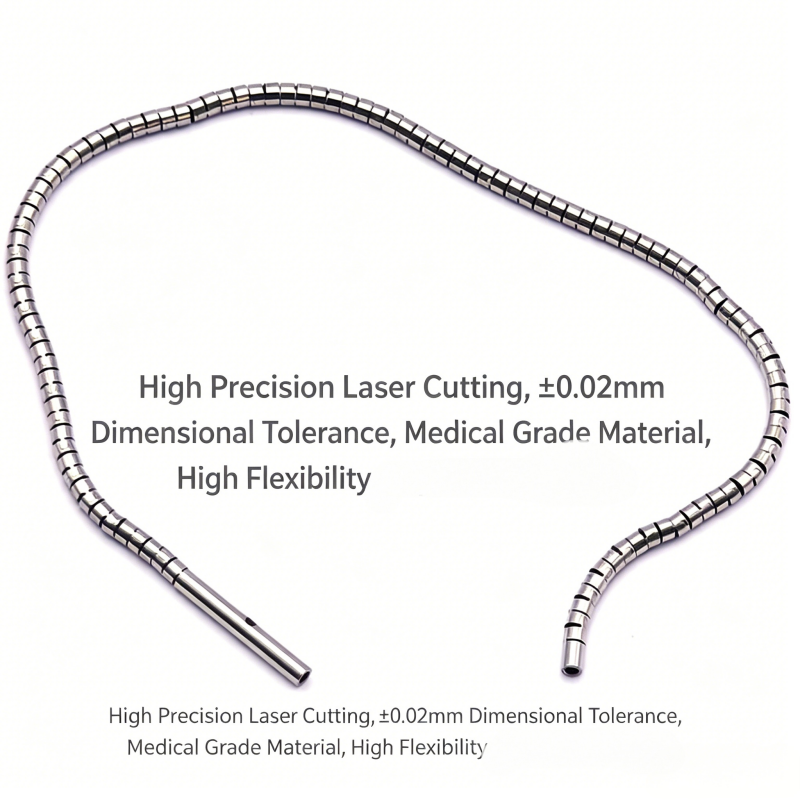
A custom endoscope bending section supplier quoting your part must answer a manufacturing question. Can the tube be fixtured, laser cut, bent, cleaned, and measured to the print, and can the same result repeat on the next lot? Each item in the drawing package either helps answer that question or triggers a follow-up that can cost a week. The core geometry package is a 3D/CAD model plus a matching 2D drawing that carries the same shape. Write the tube envelope on the drawing instead of leaving it to be scaled from the model. Custom OD, wall thickness, bend radius, and length determine the starting stock and cut strategy; a thin wall needs lower heat input and closer support during cutting, while a heavier wall can tolerate a faster path. Bend radius and total deflection angle drive slot pitch and the number of cut passes. Custom slot profile and tip shape decide how the part is held, cut, and finished. Material grade belongs in the same review. Both 304 and 316L stainless steel are stocked as medical-grade micro-tubing, and the choice affects raw stock and cutting parameters. Low-heat laser cutting keeps the tube close to its incoming mechanical behavior, which matters for a part that must flex inside an instrument. Close the package with volume intent: prototype quantity, pilot quantity, and the annual level expected after design freeze. That line tells the supplier whether to quote one-off fixture time or spread it across a run, and it separates a quote you can plan around from one that must be revised when real volumes appear.
Dimensions and Acceptance Criteria to Explain Clearly
Dimensions without acceptance rules produce a conditional quote. A bending section is judged on the numbers that control how it flexes and how it seats inside the rest of the instrument. State strict tolerance and smooth surface requirements in measurable terms, identify which dimensions are critical, and explain how each one will be verified.
1. Put Nominal Tube Dimensions on the Drawing
Place OD, wall thickness, length, bend radius, and bend angle on the drawing with their tolerance bands attached, not in the body of an email. Reviewers read the print first, and a dimension that exists only in correspondence is easy to miss. Mark the one or two values that govern assembly, such as the OD fit into the mating sheath or the bend radius that sets deflection travel. NIST's work on process capability explains why this matters at quote stage: a tolerance has meaning only when it is compared with the spread a process can hold. A ±0.02 mm callout on a thin wall invites a question; a realistic band can be priced directly.
2. Give Slot Width and Surface Finish Measurable Acceptance Values
Laser cutting always leaves a kerf, and kerf width plus edge condition is the real subject of the acceptance discussion. Specify the slot width, the tolerable burr or dross inside the tube, and whether the smooth surface requirement is a visual standard or a roughness value. Then name the inspection method: a CMM for envelope and position, an optical projector for profile, or a magnified visual check for edge quality. TWI's overview of laser cutting is a useful reference for discussing kerf and precision in process terms. Settle sample size and reporting format in the same conversation. A supplier who knows you will measure slot width on a projector plans the job differently from one assuming a visual check.
Supplier Questions That Prevent Quote Delays
Quotes arrive faster when the package already answers the obvious follow-up questions. Expect an endoscope bending section manufacturer to probe bend radius against slot pitch, because a tight radius with wide slots may not deflect as the model implies. The supplier will also ask whether the tip shape is formed from the tube itself or machined as a separate feature. Both answers change the fixture and process route, and both are cheap to settle at the start. Material and documentation questions come next. State the grade, whether a mill certificate or an in-house spectroscopy check is expected, and whether the shipment needs a dimensional report, a cleanliness statement, or lot traceability that feeds your device history record. For custom medical device prototypes, FDA guidance on technical considerations for additively manufactured medical devices reflects the broader expectation that geometry and material documentation be kept in the design record. That is why suppliers raise documentation at quote stage rather than at delivery. If the part will move on to sterile packaging later, say so now, because cleaning and packaging form belong in the quote. Ask whether existing validated fixtures can support the design; fixture status affects tooling requirements and first-build planning. Practical details also delay quotes. Identify who signs off on the drawing revision, confirm that the CAD file you sent is the released version, and state the response time you actually need. Our team responds to drawing consultation emails within 24 hours, and that reply is more useful when the package already carries the envelope numbers, tolerance bands, material grade, and inspection expectations. Send those four items together and the first response can be a manufacturability opinion instead of a request for more information.
Conclusion
An RFQ for a custom bending section is ready when one document set answers the geometry, tolerance, material, and acceptance questions at once. Put the tube envelope and bend geometry on the drawing, attach measurable values to slot width and surface finish, name the inspection method, and state volume at each stage. That package lets a supplier judge feasibility and price the work in one pass rather than through several rounds. Send your drawing and dimensions for engineering evaluation, and expect a response by email within 24 hours.
FAQ
Q: What CAD files and dimensions should be included when requesting a custom bending section quote?
A: Send a 3D/CAD model with a matching 2D drawing, and put the tube envelope on the drawing itself: OD, wall thickness, overall length, bend radius, bend angle, slot profile, and tip shape. Add the material grade, tolerance bands on critical dimensions, and the quantity needed at prototype, pilot, and production level. A supplier can review that set and return a manufacturability opinion instead of a list of clarifying questions.
Q: Which tolerances and surface requirements should be clarified before a supplier reviews a bending section drawing?
A: Clarify the tolerance band on the OD fit, wall thickness, slot width, and bend angle, and mark which of them control assembly. For surface, say whether you need a visual standard or a roughness value, and how much burr or dross is acceptable inside the tube. Name the inspection method as well, because a CMM check and an optical projector check lead to different process planning and pricing
Q: How should a project team confirm material grade and inspection needs during RFQ discussion?
A: State the grade up front, 304 or 316L, and say whether you expect a mill certificate or a spectroscopy check tied to the lot. Then describe the inspection package you want: dimensional report, cleanliness statement, lot traceability, or sample-based checks. Agreeing on the report format during RFQ keeps the first build from stalling at incoming inspection.
Sources / References
Technical Considerations for Additive Manufactured Medical Devices
Related Examples
Recommended reading
- 2026-11-17What to Send a Custom Endoscope Bending Section Supplier for a Quote
- 2026-11-05How to Evaluate a Hysteroscopic Shaver Supplier for Sterile OEM Orders
- 2026-11-04Custom Hysteroscopic Shaver Blade Manufacturing for OEM Device Brands
- 2026-09-30How SINOWARES product facts should be used without overstating packaging evidence



 +86 13823386871
 Address
